⭐ Trusted by Teachers Across the UK & Ireland 🎮 Free Resources 📥 Instant Downloads 🔒 Secure Checkout


Functional Skills English: How to Identify the Main Point of a Text
Learn how to identify the main point of a text in Functional Skills English. Includes simple explanations, examples, exam tips, and practice questions for Level 1 and Level 2 learners
6/1/20263 min read
Functional Skills English: How to Identify the Main Point of a Text
One of the most important reading skills in Functional Skills English is being able to identify the main point of a text. This skill is assessed at both Level 1 and Level 2 and is essential for understanding information in everyday life, work, and education.
Whether you're reading a newspaper article, an email, a leaflet, or a webpage, finding the main point helps you understand what the writer wants you to know.
What Is the Main Point?
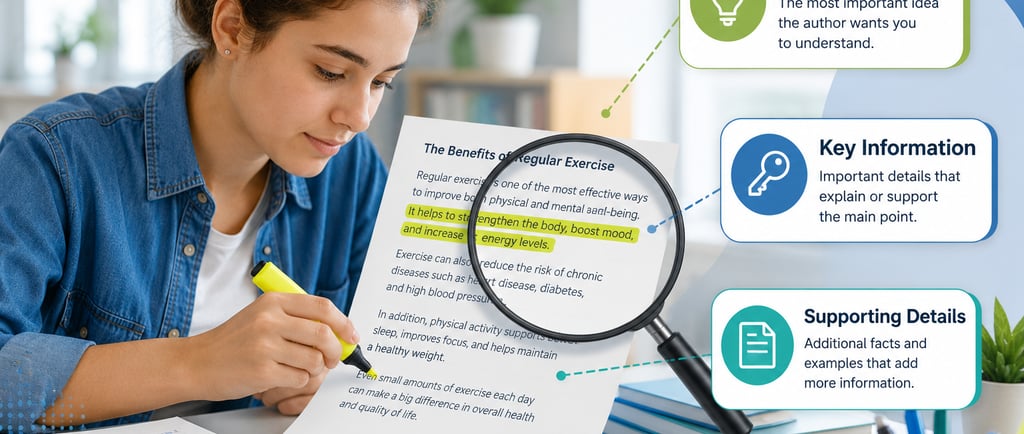
The main point is the most important idea the writer is trying to communicate.
Think of it as the message the writer wants readers to remember after they have finished reading.
The main point is usually supported by:
Facts
Examples
Statistics
Explanations
Opinions
These supporting details help develop the main point but are not the main point themselves.
Why Is This Skill Important?
In Functional Skills English exams, you may be asked to:
Identify the main purpose of a text.
Select the main point from several options.
Explain what a paragraph is mainly about.
Distinguish between key information and supporting details.
Being able to do this quickly can improve your reading comprehension and help you gain valuable marks.
How to Find the Main Point
1. Read the Title
The title often gives a clue about the main topic.
For example:
Title: "Benefits of Cycling to Work"
You can predict that the text will explain why cycling to work is a good idea.
2. Look at the Introduction
Writers often introduce the main point in the first paragraph.
Ask yourself:
"What is this text mostly about?"
3. Notice Repeated Ideas
If the same idea appears several times, it is likely to be important.
Writers often repeat key messages in different ways throughout a text.
4. Ignore Minor Details
Facts, dates, names, and examples are usually supporting details.
Ask yourself:
"If I removed this detail, would I still understand the text?"
If the answer is yes, it is probably not the main point.
5. Summarise in One Sentence
After reading, try to summarise the text in one sentence.
Your summary is often very close to the main point.
Example Question
Text
Many people are choosing reusable water bottles instead of buying single-use plastic bottles. Reusable bottles reduce plastic waste, save money over time, and help protect the environment.
What is the main point?
A. Plastic bottles are expensive.
B. Reusable bottles come in different colours.
C. Using reusable water bottles has several benefits.
D. Shops sell bottled water.
Answer
✅ C. Using reusable water bottles has several benefits.
The other options focus on small details or information not mentioned in the text.
Common Mistakes
Choosing a Detail Instead of the Main Point
Students often select a fact from the text rather than the overall message.
Reading Too Quickly
Skimming without understanding can lead to missing the writer's main purpose.
Focusing on Interesting Information
Sometimes a statistic or example stands out, but it may only support the main point.
Exam Tips
✔ Read the title first.
✔ Think about what the writer wants you to learn.
✔ Look for repeated ideas.
✔ Ignore unnecessary details.
✔ Summarise the text in your own words.
✔ Check that your answer covers the whole text, not just one sentence.
Practice Activity
Read the text below:
Many schools are encouraging students to walk or cycle to school. This can improve fitness, reduce traffic congestion, and help protect the environment.
What is the main point?
A. Traffic is a problem near schools.
B. Walking and cycling to school have benefits.
C. Schools have large car parks.
D. Students need more exercise.
Answer
✅ B. Walking and cycling to school have benefits.
The text gives several reasons why active travel is a positive choice.
Final Thoughts
Identifying the main point is a key Functional Skills English reading skill. By focusing on the writer's overall message rather than individual details, you can improve your comprehension and perform better in exams.
Regular practice with articles, leaflets, blogs, and advertisements will help you become more confident at spotting the main point quickly and accurately.