⭐ Trusted by Teachers Across the UK & Ireland 🎮 Free Resources 📥 Instant Downloads 🔒 Secure Checkout


Teaching Simplifying Fractions in Functional Skills Maths
Practical classroom strategies, visual approaches and proven teaching tips to help Functional Skills learners simplify fractions with confidence and improve exam success.
6/13/20262 min read
Teaching Simplifying Fractions in Functional Skills Maths: What Works in the Classroom
Fractions are one of those topics that can cause groans the moment they appear on the board. As Functional Skills teachers, we've all heard comments like:
"I was never any good at fractions."
"I can't do fractions."
"Fractions don't make sense."
The reality is that most learners can simplify fractions successfully once the process is broken down into clear, manageable steps.
Why Do Learners Struggle?
In my experience, learners rarely struggle with the actual process of simplifying fractions.
The real issues are usually:
🔹 Weak multiplication tables
🔹 Limited knowledge of factors
🔹 Low confidence in maths
🔹 Previous negative experiences at school
That's why I always spend a little time revisiting factors before teaching simplification.
Start with a Visual Example
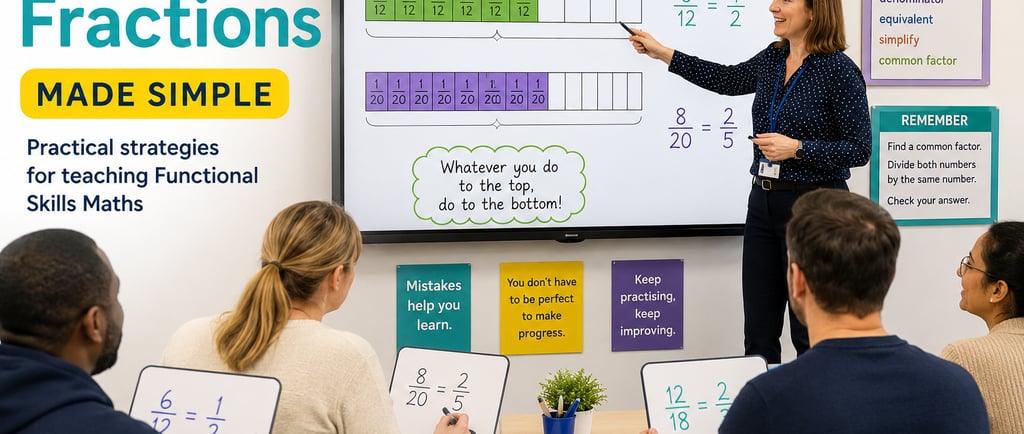
Before introducing any rules, I like to show learners a simple visual model.
Fraction A
⬛⬛⬜⬜
2 shaded parts out of 4
2/4
Fraction B
⬛⬜
1 shaded part out of 2
1/2
Learners can immediately see that both fractions represent the same amount.
This helps answer the question:
"Why do we simplify fractions?"
Because we're simply writing the same value using smaller numbers.
The Golden Rule
⭐ Whatever you do to the top number, you must do to the bottom number.
I repeat this constantly throughout the lesson.
It prevents many of the mistakes learners make later on.
A Classroom Example
Simplify 12/18
Step 1: Find a Common Factor
Factors of 12
1, 2, 3, 4, 6, 12
Factors of 18
1, 2, 3, 6, 9, 18
Common factors:
✅ 1
✅ 2
✅ 3
✅ 6
Highest Common Factor = 6
Step 2: Divide Both Numbers
12 ÷ 6 = 2
18 ÷ 6 = 3
Step 3: Write the Answer
12 2
── = ──
18 3
✅ Answer = 2/3
A Useful Classroom Check
Once learners have simplified a fraction, I always ask:
"Can both numbers still be divided by the same number?"
For example:
6
─
9
Both divide by 3.
6 ÷ 3 = 2
9 ÷ 3 = 3
So:
6 2
─ = ─
9 3
If learners can still divide both numbers, they haven't finished yet.
Common Mistakes
❌ Dividing Only One Number
Learner answer:
12
── = 2/18
18
This is incorrect because only the numerator has changed.
Remember:
⭐ Top and bottom must be divided by the same number.
❌ Stopping Too Early
Learner answer:
12 6
── = ─
18 9
This is better, but it is not fully simplified.
One more step gives:
6 2
─ = ─
9 3
Activities That Work Well
Over the years, these have been some of the most successful activities in my Functional Skills classes:
🎯 Fraction Match-Up
Match fractions to their simplified forms.
Example:
FractionMatch8/122/310/201/212/163/4
🎯 Spot the Mistake
Show incorrect solutions and ask learners to explain what went wrong.
This develops deeper understanding and encourages discussion.
🎯 Whiteboard Challenge
Display a fraction.
First learner to correctly simplify it scores a point.
Simple, quick and highly engaging.
Functional Skills Exam Tips
Before Writing Your Answer
☑ Find a common factor.
☑ Divide both numbers by the same amount.
☑ Check whether it can be simplified again.
☑ Leave your answer in its simplest form.
My Top Teaching Tip
If learners struggle with simplifying fractions, don't spend more time on fractions.
Spend more time on factors.
When learners can quickly identify factors and multiplication facts, simplifying fractions becomes much easier and far less intimidating.